


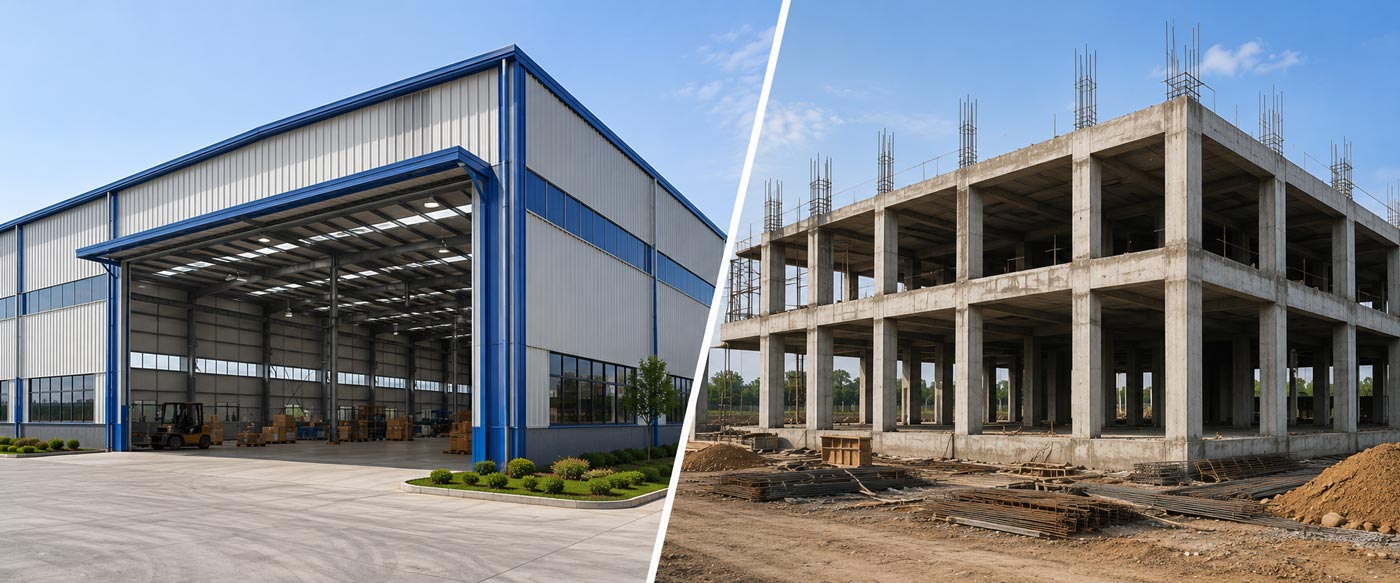
PEB vs RCC Building – Which Is Better for Industrial Construction in 2026?
When planning a warehouse, factory, industrial shed, logistics center, or commercial building, one of the most common questions is:
Should you choose a Pre-Engineered Building (PEB) or a Reinforced Cement Concrete (RCC) building?
Both construction methods have their advantages, but the right choice depends on your project requirements, budget, timeline, and future expansion plans. This guide compares PEB and RCC buildings across key factors to help you make an informed decision.
What Is a PEB Building?
A Pre-Engineered Building (PEB) is a steel structure designed and manufactured in a factory before being assembled on-site. The building components are engineered according to project specifications, allowing for faster construction and optimized material usage.
PEB structures are commonly used for:
- Warehouses
- Industrial sheds
- Manufacturing plants
- Logistics parks
- Commercial buildings
- Cold storage facilities
- Aircraft hangars
What Is an RCC Building?
An RCC (Reinforced Cement Concrete) Building is constructed using concrete reinforced with steel bars. Most construction activities are carried out on-site, including formwork, reinforcement placement, concreting, curing, and finishing.
RCC buildings are commonly used for:
- Residential buildings
- Apartments
- Schools
- Hospitals
- Multi-story office buildings
- Institutional projects
PEB vs RCC: Detailed Comparison
Construction Speed
PEB buildings are manufactured in a factory while foundation work is carried out simultaneously on-site. This significantly reduces project timelines.
RCC construction requires multiple stages such as shuttering, reinforcement, concreting, and curing, which take more time.
Winner: PEB
Project Cost
PEB structures are designed using optimized steel sections, reducing material consumption and labor costs.
RCC buildings generally involve higher labor requirements, longer project durations, and increased site expenses.
Winner: PEB
Structural Weight
PEB buildings are lighter than RCC structures because steel offers high strength with lower weight.
RCC buildings are significantly heavier and require larger foundations.
Winner: PEB
Future Expansion
One of the biggest advantages of PEB construction is flexibility. Additional bays and extensions can be added relatively easily.
Expanding an RCC structure often requires major structural modifications.
Winner: PEB
Maintenance
Modern steel structures are protected with corrosion-resistant coatings and require limited maintenance.
RCC buildings may develop cracks, seepage issues, and deterioration over time if not maintained properly.
Winner: PEB
Design Flexibility
PEB buildings offer large column-free spans, making them ideal for warehouses and industrial facilities.
RCC structures often require more internal columns, limiting open space.
Winner: PEB
Durability
Both PEB and RCC buildings can provide long service life when designed and maintained properly.
Modern steel buildings can easily last 40–60 years or more.
Winner: Tie
Earthquake Resistance
Steel structures are generally more flexible and absorb seismic forces effectively.
RCC buildings can also be designed for seismic resistance but often experience higher structural loads due to their weight.
Winner: PEB
Quick Comparison Table
| Factor | PEB Building | RCC Building |
| Construction Speed | Very Fast | Slow |
| Cost Efficiency | High | Moderate |
| Expansion Capability | Easy | Difficult |
| Structural Weight | Light | Heavy |
| Maintenance | Low | Moderate |
| Clear Span Space | Excellent | Limited |
| Earthquake Performance | Excellent | Good |
| Construction Waste | Low | Higher |
| Sustainability | High | Moderate |
| Industrial Applications | Excellent | Good |
When Should You Choose a PEB Building?
A PEB building is the ideal choice if you need:
- Warehouse construction
- Industrial shed construction
- Factory buildings
- Logistics parks
- Distribution centers
- Cold storage facilities
- Commercial steel buildings
- Fast project completion
- Future expansion flexibility
When Should You Choose an RCC Building?
An RCC building may be suitable for:
- Residential projects
- Apartments
- Schools
- Hospitals
- High-rise buildings
- Institutional buildings
- Projects requiring heavy concrete construction
Why Most Industrial Projects Prefer PEB Today
Industries are increasingly choosing PEB construction because it offers:
- Faster completion
- Lower overall costs
- Reduced maintenance
- Better space utilization
- Sustainable construction
- Easier expansion
- High structural reliability
For warehouses, factories, logistics centers, and industrial facilities, PEB has become the preferred construction method across India.
Frequently Asked Questions
Is PEB cheaper than RCC?
In most industrial and warehouse projects, PEB construction is generally more cost-effective due to optimized steel design, reduced labor requirements, and faster execution.
Which building lasts longer, PEB or RCC?
Both can last for decades when properly designed and maintained. Modern PEB structures typically offer a service life of 40–60 years or more.
Is PEB suitable for warehouses?
Yes. PEB is considered one of the best solutions for warehouse construction because it provides large clear spans, faster construction, and lower maintenance.
Is PEB earthquake resistant?
Yes. Properly engineered steel structures perform exceptionally well in seismic zones due to their flexibility and strength.
When comparing PEB vs RCC buildings, the best choice depends on your project goals. For industrial sheds, warehouses, manufacturing plants, logistics parks, and commercial steel buildings, Pre-Engineered Buildings offer significant advantages in speed, cost efficiency, flexibility, and scalability.
As businesses increasingly focus on faster project delivery and long-term value, PEB construction continues to emerge as the preferred solution for modern industrial development.

